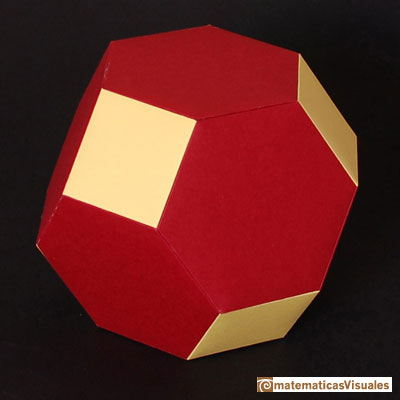
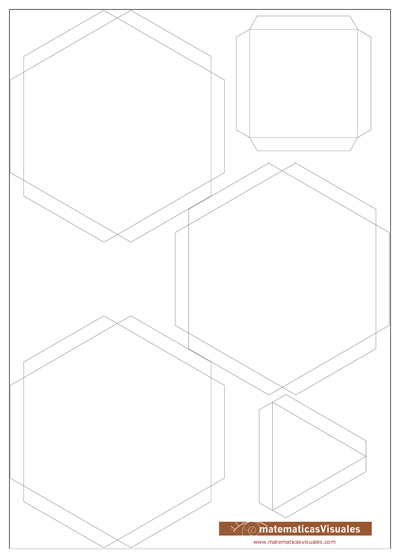
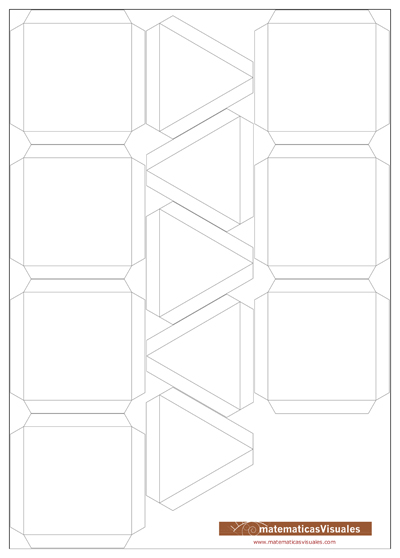
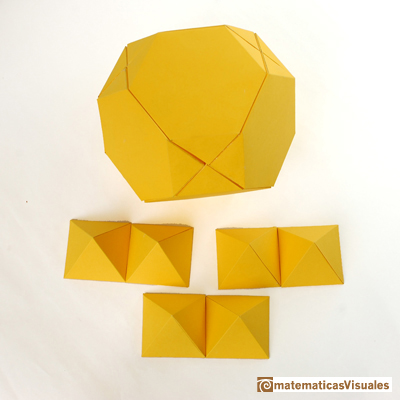
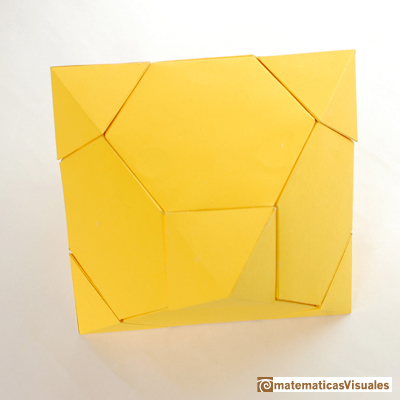
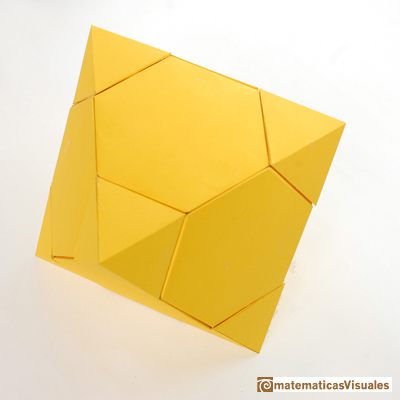
Using eight half cubes we can make a truncated octahedron. The cube tesselate the space an so do the truncated octahedron. We can calculate the volume of a truncated octahedron.
En esta página vamos a calcular ese volumen de otro modo.
The volume of a truncated octahedron can be easily calculated if we know the volume of an octahedron.
We can calculate the volume of an octahedron of edge length 3:
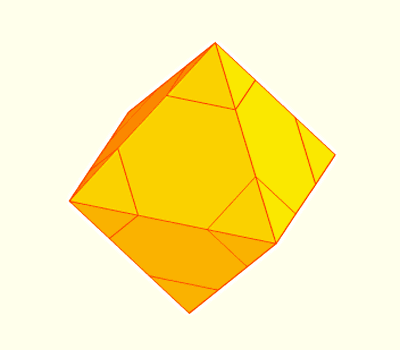
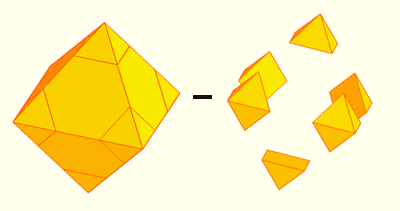
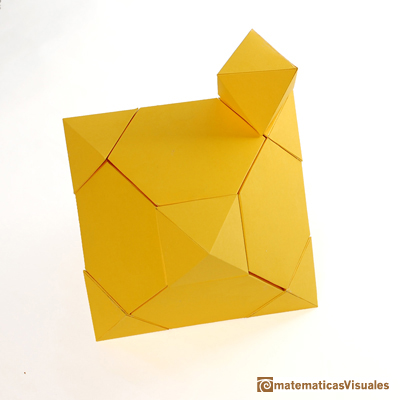
To calculate the volume of a truncated octahedron we have to remove to an octahedron of edge length 3
six pyramids. These six pyramids make 3 octahedra of edge length 1.
Además este poliedro es un sólido arquimediano. Pertenece a la segunda familia de poliedros más famosa.
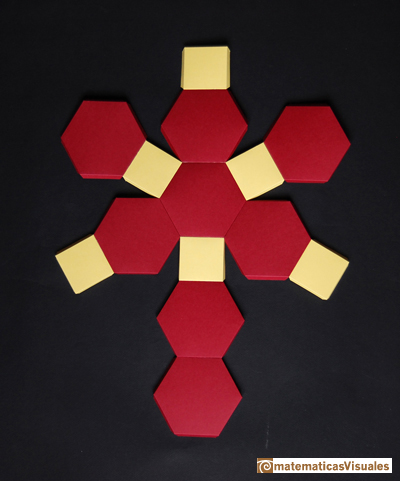
Sus caras son poliedros regulares no todos iguales. En este caso vemos que tiene 6 cuadrados y 8 hexágonos. Todos sus vértices tienen que ser iguales.
Si sabemos el volumen del octaedro ya podemos calcular el volumen del tetraedro pues sabemos que es la cuarta parte.
Hemos podido calcular el volumen del octaedro y el del tetraedro sin recurrir a la fórmula del volumen de la pirámide. Manipulando las
construcciones de los poliedros y viendo sus propiedades. También hemos usado la relación entre los volúmenes de figuras semejantes.
REFERENCES
Hugo Steinhaus, Mathematical Snapshots, Dover Publications (third edition, 1999)
Leonardo da Vinci made several drawings of polyhedra for Luca Pacioli's book 'De divina proportione'. Here we can see an adaptation of the truncated octahedron.
Using eight half cubes we can make a truncated octahedron. The cube tesselate the space an so do the truncated octahedron. We can calculate the volume of a truncated octahedron.
The first drawing of a plane net of a regular tetrahedron was published by Dürer in his book 'Underweysung der Messung' ('Four Books of Measurement'), published in 1525 .
Leonardo da Vinci made several drawings of polyhedra for Luca Pacioli's book 'De divina proportione'. Here we can see an adaptation of the cuboctahedron.
Leonardo da Vinci made several drawings of polyhedra for Luca Pacioli's book 'De divina proportione'. Here we can see an adaptation of the dodecahedron.
Leonardo da Vinci made several drawings of polyhedra for Luca Pacioli's book 'De divina proportione'. Here we can see an adaptation of the stellated octahedron (stella octangula).
The stellated octahedron was drawn by Leonardo for Luca Pacioli's book 'De Divina Proportione'. A hundred years later, Kepler named it stella octangula.
The compound polyhedron of a cube and an octahedron is an stellated cuboctahedron.It is the same to say that the cuboctahedron is the solid common to the cube and the octahedron in this polyhedron.
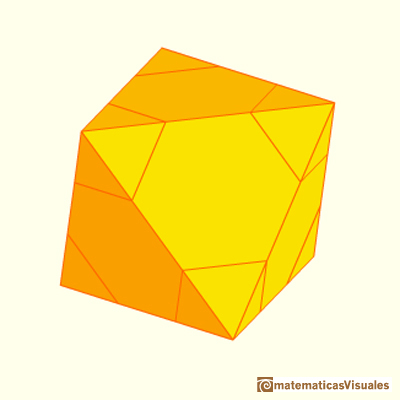
When you truncate a cube you get a truncated cube and a cuboctahedron. If you truncate an octahedron you get a truncated octahedron and a cuboctahedron.



 NEXT
NEXT

 PREVIOUS


