

|

|

|


A pyramid is a polyhedron with a polygonal face (known as the base) and the other faces are triangles meeting at a common point (the apex of the pyramid). These faces (lateral faces) are triangles.
One particular case is when the base is inscribed in a circle. In the first mathlet we can play with pyramids that have a regular polygon as a base. If the apex is above the center of this circle, then we can say that the pyramid is a right pyramid. A regular pyramid is a right pyramid whose base is a regular polygon.
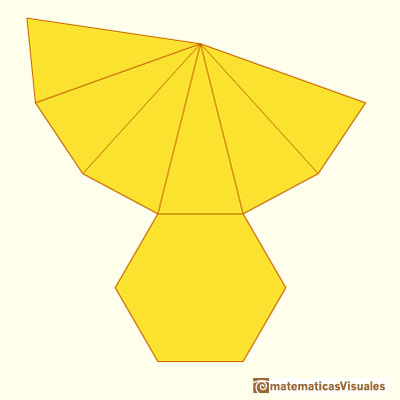
The main interest of this page is to see how a pyramid can be developed into a plane.
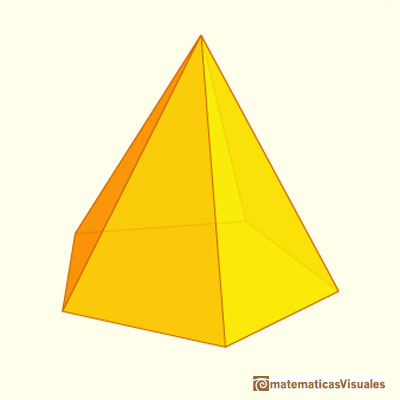
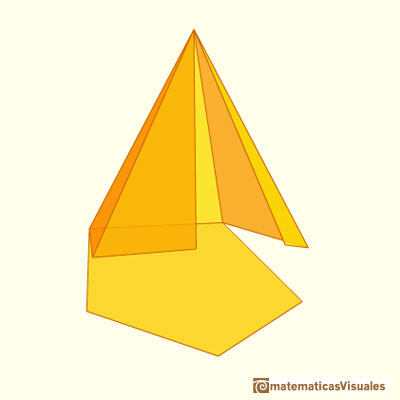
Plane development or net of a pentagonal pyramid:
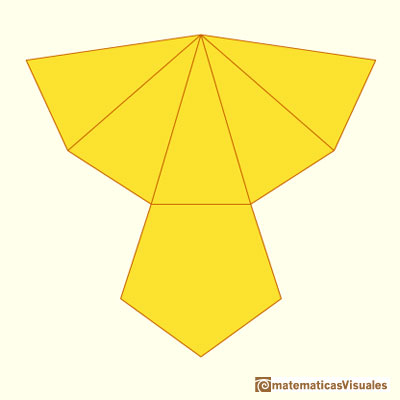
Another example, the net of an hexagonal pyramid:
To calculate the lateral surface area of a pyramid we need the slant height. The slant height of a pyramid if the distance between the apex and the center of a side of the base. It is the altitude of a lateral face. There is a relation between the slant height and the height of a pyramid (Pythagorean theorem).
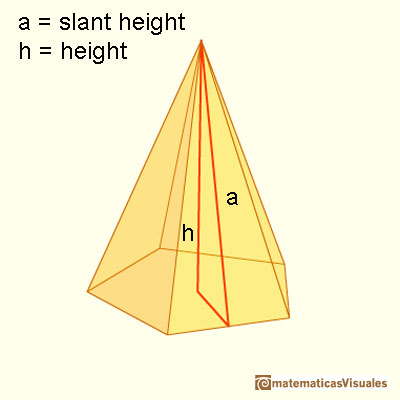
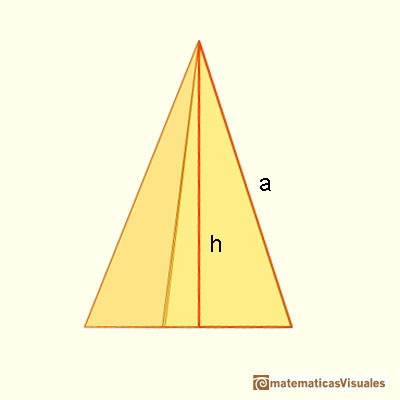
We are going to calculate the lateral surface area of a pyramid. If P is the base perimeter, the formula for the lateral surface area of a pyramid (lateral faces are triangles) is like the formula for the area of a triangle:
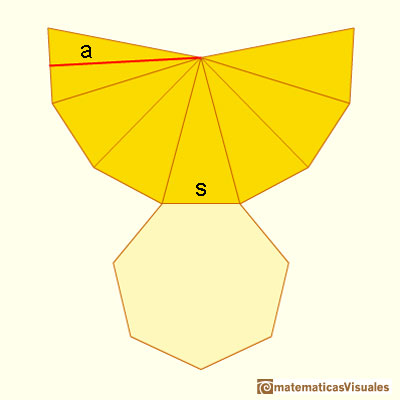
When we study the lateral surface area of a cone, the formula will be similar (as Kepler and the area of a circle.)
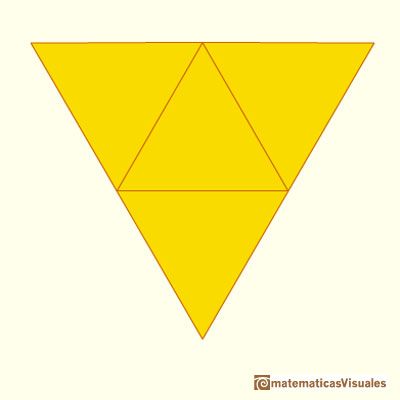
The most regular pyramid is a tetrahedron.It is a platonic solid made by four equilateral triangles. Then a tetrahedron is a particular case of a triangular pyramid.
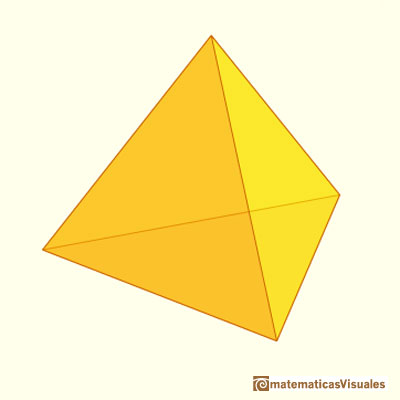
And this is the plane net of a tetrahedron:
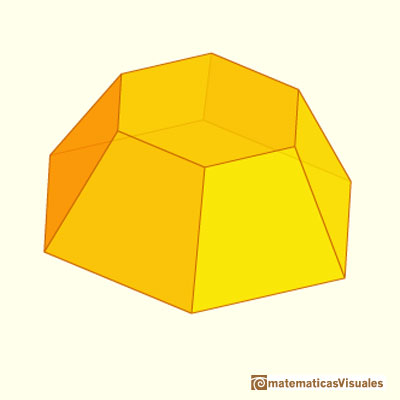
When we cut a pyramid by a plane parallel to the base we get a pyramidal frustum (or a truncated pyramid).
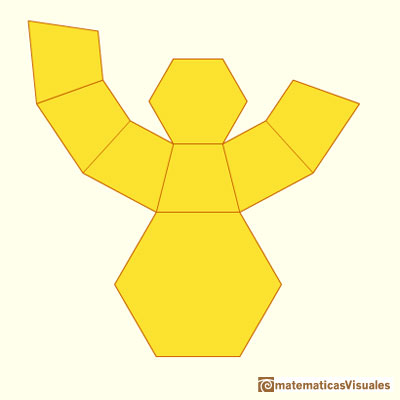
For example, this is an hexagonal frustum:
And this is its plane net:
Another example:
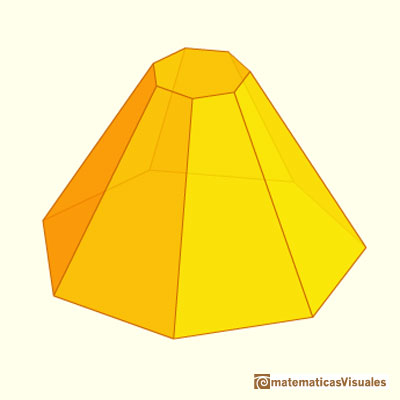
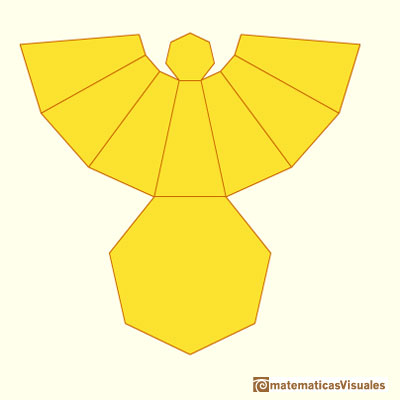
As before, we need the slant height to calculate the lateral surface area of a frustum:
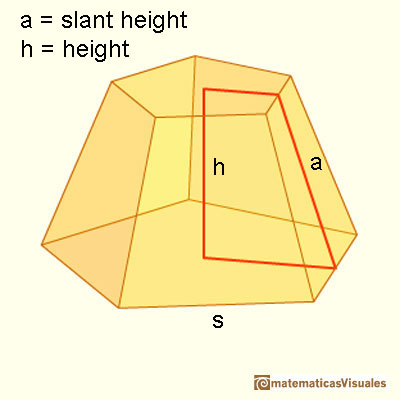
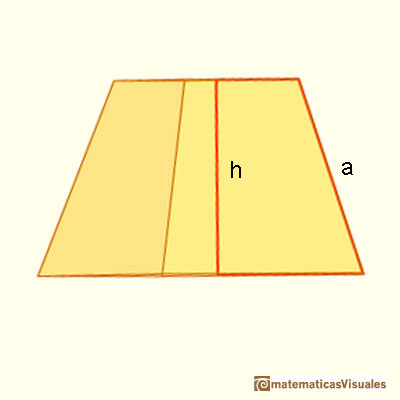
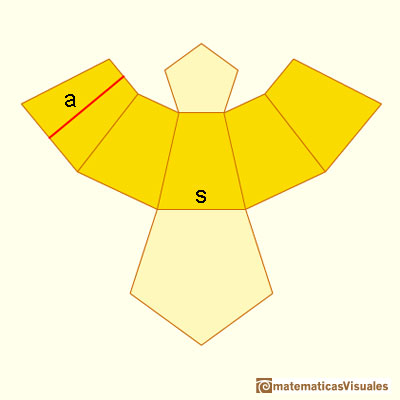
If P is the bottom base perimeter and p the top base perimeter, the formula for the lateral surface area is like the formula for the area of a trapezoid (lateral faces are congruent trapezoids):
In the examples above bases were regular polygons. But we can consider pyramids whose bases are not regular polygons. In the next mathlet, bases are non-regular polygons (although they are inscribed in a circle and they are convex polygons). Each time we change the number of sides of the base a new prism is generated with sides randomly drawn:
 NEXT
NEXT

 PREVIOUS

MORE LINKS


