

|

|

|


Knowing the result, Archimedes considered a secondary circle with the same area than the ellipse.
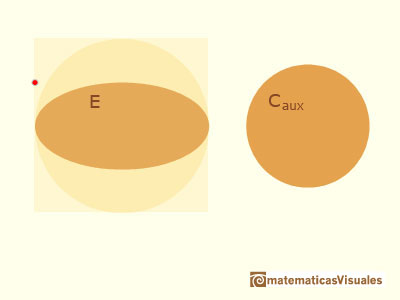
The radius of this circle is:
Archimedes wanted to probe that the area of the ellipse is equal to the area of this secondary circle
Archimedes considered an auxiliary polygon similar to P', the polygon inscribed in the auxiliary circle C'.
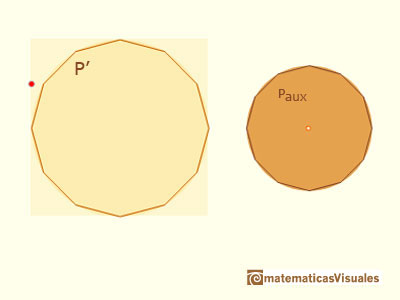
The relation between the areas of these two similar polygons is:
Archimedes estarted his double 'reductio ad absurdum'.
 If posible, let the secundary circle greater
than the ellipse.
If posible, let the secundary circle greater
than the ellipse.

"We can then inscribe in the secundary circle an equilateral polygon of 4n sides such that its area is greater than that of the ellipse. [cf. On the Sphere and Cylinder, I. 6.]" (Archimedes)
Then

Then we can consider a similar polygon in the auxiliary circle and the corresponding polygon in the ellipse.
"Supose that P' denotes the area of the polygon inscribed in the auxiliary circle, and P that of the polygon inscribed in the ellipse." (Archimedes)
We already know that
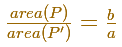
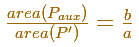
Then
"But this is imposible, because the later polygon is by hypothesis greater than the ellipse, and a fortiory greater than P.

Hence the secondary circle is not greater than the ellipse." (Archimedes)
If posible, let the secundary circle be
less than the ellipse.

In this case we inscribe in the ellipse a polygon P with 4n equal sides such that

Archimedes consider polygon P' inscribed to the auxiliary circle and a similar polygon inscribed in the secondary circle.
As before
which is imposible

This completes the double reductio ad absurdum proof.
"Hence the secondary circle, being neither greater nor less than the ellipse, si equal to it; and the required result follows."(Archimedes)
"In esence, Archimedes has simply given a rigorous exhaustion proof of the intuitively evident fact that the area of the
ellipse is b/a times the area  of its auxiliary circle, corresponding to the observation that the circle is transformed
into the ellipse by shrinking its vertical dimension by the factor b/a" (C. H. Edwards)
of its auxiliary circle, corresponding to the observation that the circle is transformed
into the ellipse by shrinking its vertical dimension by the factor b/a" (C. H. Edwards)
REFERENCES
 NEXT
NEXT

 PREVIOUS

MORE LINKS


