Inversion in a circle is a transformation that preserves the magnitude of angles but each angle is mapped to an
angle of opposite sign. The sense or direction of each angle is reversed.
Inversion in a circle is an anticonformal mapping (like a reflection in a line).
In particular, inversion is a mapping that preserves the angle of intersection of two circles. Orthogonal circles
(or lines) invert into orthogonal circles (or lines). A circle orthogonal to the circle of inversion is mapped into
itself.
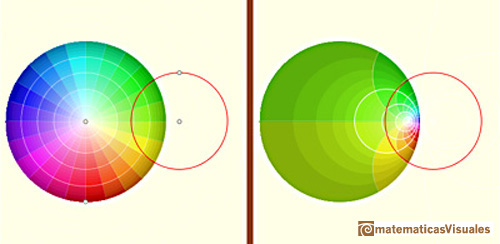
All the lines through a point and all the circles concentric with the same point as a center can be seen as two
particular cases of coaxal sistem of circles. These two coaxal sistems are orthogonal. The lines form a coaxal system
of intersecting type and the concentric circles are a non-intersecting coaxal system. These coaxal systems are mapped
into two orthogonal coaxal systems:
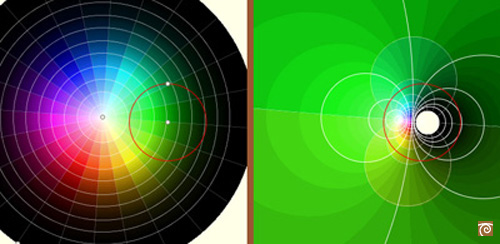
Every "small" rectangle is transformed into an "small" rectangle:
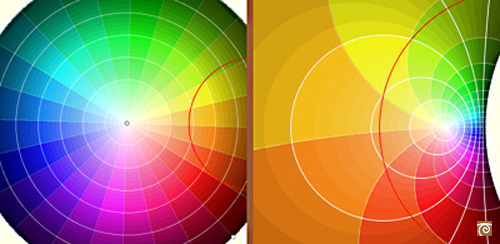
In this picture we can see how the order of colors is reversed:
REFERENCES
Hilber and Cohn-Vossen - Geometry and the Imagination (pag. 253) - Chelsea Publishing Company
Coxeter - Introduction to Geometry - Wiley and Sons.
Pedoe - Circles, a Mathematical View - Dover
Rademacher and Toeplitz - The Enjoyment of Mathematics
Ogilvy - Excursions in Geometry (pag. 24)- Oxford University Press
MORE LINKS

Complex power functions with natural exponent have a zero (or root) of multiplicity n in the origin.

A polynomial of degree 2 has two zeros or roots. In this representation you can see Cassini ovals and a lemniscate.

A complex polinomial of degree 3 has three roots or zeros.

Every complex polynomial of degree n has n zeros or roots.

Every complex polynomial of degree n has n zeros or roots.

Podemos modificar las multiplicidades del cero y del polo de estas funciones sencillas.

The Complex Exponential Function extends the Real Exponential Function to the complex plane.

The Complex Cosine Function extends the Real Cosine Function to the complex plane. It is a periodic function that shares several properties with his real ancestor.

The Complex Cosine Function maps horizontal lines to confocal ellipses.

Multifunctions can have more than one branch point. In this page we can see a two-valued multifunction with two branch points.

The complex exponential function is periodic. His power series converges everywhere in the complex plane.

The power series of the Cosine Function converges everywhere in the complex plane.

We will see how Taylor polynomials approximate the function inside its circle of convergence.




 NEXT
NEXT

 PREVIOUS

