

|

|

|


"For problems involving directions from a fixed origin (or 'pole') O, we often find it convenient to specify a point P by its polar coordinates

where  is the
distance OP and
is the
distance OP and
 is the angle that the direction OP makes with a given initial line OX, which may be identified with the x-axis of
rectangular Cartesian coordinates. Of course, the point
is the same as
is the angle that the direction OP makes with a given initial line OX, which may be identified with the x-axis of
rectangular Cartesian coordinates. Of course, the point
is the same as
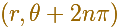 for any integrer n
"
(Coxeter, p.110)
for any integrer n
"
(Coxeter, p.110)
We can use Polar coordinates for describing spirals, for example.
Coxeter introduce the Equiangular Spiral (or 'Logaritmic spiral') as the result of a continuous dilative rotation.
The polar equation of the Equiangular Spiral is

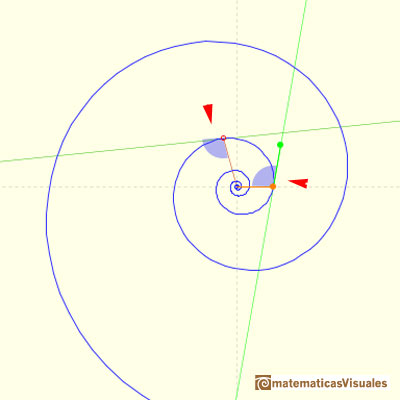
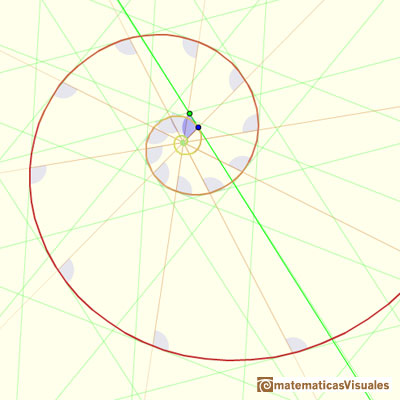
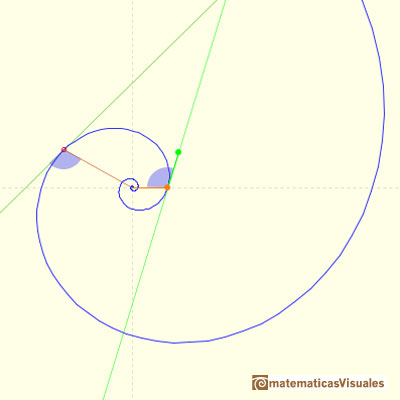
It receives the name of equiangular because the angle between the radius vector and the tangent is constant.
If  is the angle between the position
vector OP and the tangent at P then (in general, in polar coordinates)
is the angle between the position
vector OP and the tangent at P then (in general, in polar coordinates)
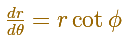
In the Equiangular spiral case, we can write

Calculating the derivative

Then
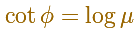
The angle between the position vector OP and the tangent at P is a constant and we can write the Equiangular spiral equation
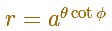
This spiral was called "spiral mirabilis" by Jacob Bernouilli.
In the next video you can see a particular case: the Golden Equiangular Spiral. This spiral is related with the Golden Rectangle.
REFERENCES
 NEXT
NEXT

 PREVIOUS

MORE LINKS


