

|

|

|


Bonaventura Cavalieri(1598-1647) was an italian mathematician. He was a precursor of infinitesimal calculus. Cavalieri, Kepler and other mathematicians, who lived during the century preceding Newton and Leibniz, invented and used intuitive infinitesimal methods to solve area and volume problems.
Twenty years after the publication of Kepler's Stereometria Doliorum, Cavalieri wrote a very popular book: Geometria indivisibilibus (1635).
In this book, the Italian mathematician used what is now known as Cavalieri's Principle: If two solids have equal altitudes, and if sections made by planes parallel to the bases and at equal distances from them are always in a given ratio, then the volumes of the solids are also in this ratio.
Cavalieri's Principle is also call the method of indivisibles. "Cavalieri made the notion of the indivisible the basis of a geometrical method of demonstration. He didn't explained precisely what he understood by the word indivisible, which he employed to characterize the infinitesimal elements used in his method. Cavalieri conceived of a surface as made up an indefinite number of equidistant parallel lines and of a solid as composed of parallel equidistant planes, these elements being designated the indivisibles of the surface and of the volume respectively." (C.H. Edwards)
Zu Geng, born about 450, was a chinese mathematician who used what is now know as the Principle of Liu Hui and Zu Geng to calculate the volume of a sphere. Liu-Zu theory is equivalent to Cavalieri's Principle. Then, chinese mathematicians had used this principle for more than one millennium before Cavalieri. You can read a biography of Zu Geng in MacTutor and the article Zu-Geng's axiom vs Cavalieri's theory by Ji-Huan He.
A well known application of Cavalieri's Principle is used to calculate the volume of a sphere. We can compare the area of a section of an hemisphere and the area of a section of a body that is a cylinder minus a cone.
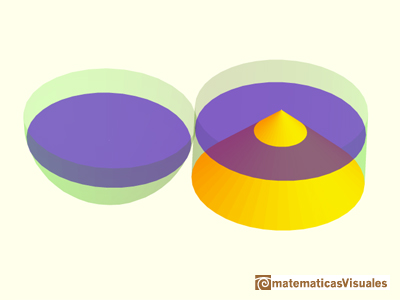
This two areas are equal. Then the two bodies have the same volume. It is very easy to calculate the volume of the second body(because we know how to calculate the volume of a cylinder minus the volume of a cone), then we get the volume of the hemisphere.
We need to probe that the area of the disc is equal to the area of the annulus (for each section):
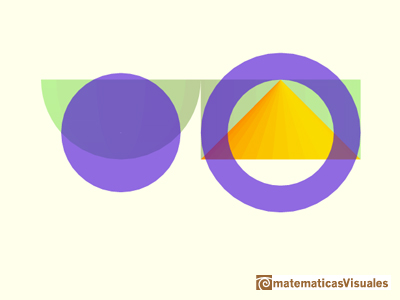
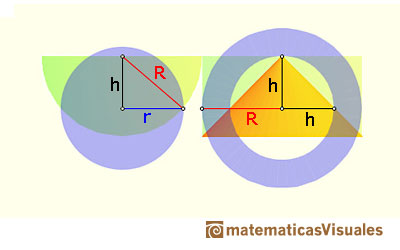
For each altitude h, the area of the disc is:
and the area of the annulus is:
Then, for each altitude the two sections have equal area.
Using Cavalieri's Principle we can deduce:
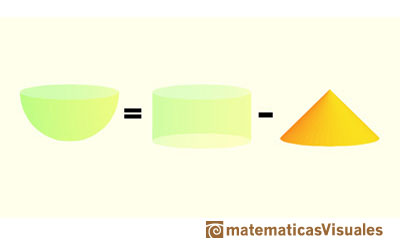
Using the formulas for the volume of a cylinder and of a cone we can write the volume of an hemisphere:
Then, the volume of a sphere of radius R is (as Archimedes already knew, 1800 years before):
Interesting application of Cavalieri's Principle: in the video Without integration, why is the volume of a paraboloid half of its inscribing cylinder? Mathemaniac developed an idea from Yehuda Simcha Waldman to calculate the volume of a paraboloid. Yehuda Simcha made an interactive application showing his idea.
REFERENCES
 NEXT
NEXT

 PREVIOUS

MORE LINKS


